

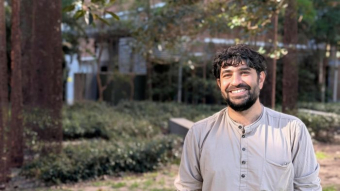
A New Academic Chapter for Gautam at UNSW
Dr Bhatia has joined UNSW as a Green Fellow, bringing more than a decade of experience in constitutional law practice and scholarship to a new phase of academic work.
During his Fellowship, he will develop a new monograph while contributing to the Gilbert + Tobin Centre of Public Law and the UNSW Resilient Democracy Lab. He is also looking forward to becoming embedded in the faculty through conversations, reading groups, collaborative projects, and seeing what other opportunities emerge.
“I’ve been coming to UNSW for a few years for the December comparative constitutional law round-table, and the I-CON Winter/Summer School. I’ve loved being here, and I’ve found the faculty to be generous, inclusive, and rigorous.”
“The Green Fellowship gives me a chance to deepen some of those intellectual collaborations, and also the time and space to go deeper into my own research, after many years of being at the intersection of constitutional law practice and constitutional law scholarship.”
Since 2014, Dr Bhatia has worked at the intersection of constitutional law practice and comparative constitutional law scholarship, in India and elsewhere. He says the Fellowship has come at the right time to bring these experiences together.
“It felt the right time to really draw on the insights of what has now been around 12 years of being in practice as well and synthesise them into an academic project.”
Dr Bhatia says his experience so far as a Green Fellow has been different from his previous short visits to UNSW, giving him the opportunity to become more embedded in the faculty and build connections.
“I think you feel a lot more rooted and rounded in the faculty and its work, because obviously when you’re visiting, the cross-section of people you meet is a smaller one. And of course, you’re there temporarily.”
“But now it feels like you’re part of the community and contributing to it.”
The Fellowship will also involve supporting PhD students and contributing to UNSW’s collaborative research culture.
“Having received the benefit of excellent supervision during my PhD from Professor Sandy Fredman, and having had a wonderful cohort that met every week, I’m keenly aware of how important it is to create a good and collaborative environment for PhD work.”
“What I’m looking forward to most is ensuring that the students I supervise have that environment.”
In Practice and Scholarship
Dr Bhatia says his experience as a practitioner and scholar has been mutually influential. His research on horizontal rights and socio-economic rights litigation led him to consider how private power and broader economic structures shape constitutional law.
“My PhD thesis at the University of Oxford was about horizontal rights, which drew me into issues around the political economy, since they inevitably involved questions of private power.”
“My constitutional law practice involving socio-economic rights likewise impressed on me the importance of a critique of political economy approach towards doctrinal constitutional law.”
He has also drawn on comparative scholarship in his legal practice, including South African free speech law in a case before the Bombay High Court and comparative constitutional law in a housing rights case.
“I think it’s been a case where the practice informs the scholarship and the scholarship informs the practice.”
His work on the Article 370 case, concerning the removal of Jammu and Kashmir’s constitutionally guaranteed autonomy, was particularly influential.
“Working on that case made me understand the necessity of understanding constitutions as power-maps, and placing the question of power front and centre in constitutional analysis.”
For Dr Bhatia, the most rewarding moments in his work come when legal arguments have a tangible effect, as well as when legal ideas continue to influence wider public and academic conversations.
“In that free speech case, when the Bombay High Court basically held that the fact-check unit that the Government of India had put in place was unconstitutional because they had created their own fact-check unit and would then check facts about themselves, it was a good feeling because your arguments had a direct impact on an outcome.”
He also sees the courtroom as a place where legal ideas can shape wider conversations.
“The courtroom becomes a site for creating a kind of vocabulary or grammar around constitutionalism.”
At the same time, the work can also be difficult, particularly when cases do not result in the outcomes he believes are necessary. As a scholar, the impact of his work is often less immediate and more difficult to measure.
“You just want to do the right thing or do good scholarship that is actually broadly within an egalitarian, progressive framework. But you can never know what impact it will have.”
Dr Bhatia says maintaining perspective, and remaining connected to others, helps him navigate those challenges. He also finds journalling useful for clarifying his thoughts.
A New Book
These experiences have informed the book he is developing during his Green Fellowship at UNSW. The project will examine central concepts in comparative constitutional law through a critical political economy lens.
“In this book, I will be interrogating some core concepts in comparative constitutional law, such as meaningful engagement in socio-economic rights litigation, proportionality, ‘the People’ and so on, using the critique of political economy and the theoretical framework of Evgeny Pashukanis as a frame.”
The project was prompted by the limits Dr Bhatia has encountered when constitutional law engages with broader economic structures.
“Being in practice for many years and seeing that there are so many external hard limits on what you can achieve through constitutionalism, which are just to do with the fact that we have structured our economies in certain ways.”
“So, you go to court about a right to housing and you find that basically, even if the judge is well intentioned and wants to do something, there is the external reality of the manner in which we have commodified housing, that makes it impossible to really achieve certain things.”
The book will contribute to Dr Bhatia’s broader aim of placing political economy at the centre of constitutional analysis while retaining a doctrinal and comparative approach.
“I want to centre the critique of political economy in our understanding of constitutional law, while continuing to work within a doctrinal and comparative framework.”
“I think this will be especially helpful when we confront what will undoubtedly be the big questions in the coming years – the climate catastrophe, inequality, and State-sanctioned violence.”
“It will be particularly important to have clarity both on what constitutionalism can do – but also on what it can’t do – to address these issues.”
Looking ahead
At UNSW, he is also looking forward to conversations and collaborations that may come up with colleagues across the faculty.
“I think other collaborations are still taking shape in interesting ways.”
“I think things will emerge over time. These are definitely things I want to take over.”
“I think it’s more about being open to that and letting things develop as they come. I try to come to campus every day because often it’s the unexpected interactions that lead to interesting things. You just bump into someone in the corridor and start talking, and then something emerges from that.”
Looking ahead, Dr Bhatia hopes his work will remain connected to the realities it seeks to understand and remembered as work that was thoroughly grounded in the material realities of the world and was intellectually honest.
Making the most out of Sydney life
Alongside his academic work, Dr Bhatia is making the most of opportunities to pursue interests that have arose by being in Sydney. He has begun surfing lessons, returned to fencing and joined reading groups connected with local bookshops.
“I thought I should come here and do what I can’t do elsewhere. So, I’ve begun surfing lessons. It was fun. I still can’t stand up on the board, but that’s okay.”
“I used to do fencing when I was doing my PhD in Oxford many years ago and I couldn’t do it a lot in India because it was a little hard. The fencing academy in Delhi is quite far away. So, I’ve taken that up again in Alexandria.”
“When I used to come here, I used to love going on this run from Coogee to Bondi, specifically at night, because in India it’s a little hard to run at night and there are also air quality issues in Delhi where I came from. So, it was the great thing to be able to go at 11 PM and just do a run.”
“I’m trying to do all these things that are only there in Sydney and part of being in Sydney.”
For Dr Bhatia, the Fellowship offers both the time to advance his research and the opportunity to contribute to an academic community he has valued for several years.
“It’s a very wonderful intellectual atmosphere to come to and very well supported.”
“I think that it’s a city that has pretty much everything, whatever your interests are. It’ll be a very fulfilling experience, both being in Sydney and being part of UNSW on the scholarship.”