Books

2025

add
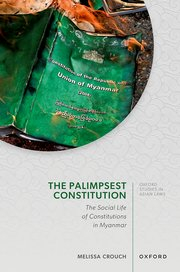
The Palimpsest Constitution

Melissa Crouch 

Since the mid-20th century, many postcolonial states have engaged in multiple constitution-making exercises, with the turnover in written constitutions often due to coups or internal conflict. Conversely, people have resisted authoritarian rule through alternative constitution-making. The reality that most countries have had numerous official and unofficial constitutional texts begs the question: How do past constitutions matter in the present? 

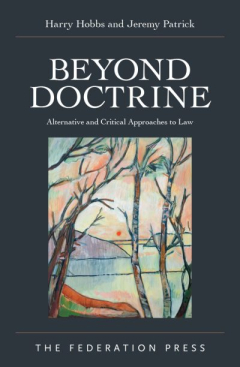
Beyond Doctrine

Harry Hobbs and Jeremy Patrick (eds). 

Traditionally law has been viewed as a system of rules to be analysed and applied with mechanical logic. But instead of thinking of law as a “closed” system that can only be understood through traditional legal research and analysis, it can be conceptualised as an “open” system in which insights, approaches, and influences from other disciplines can be brought to bear. Beyond Doctrine: Alternative and Critical Approaches to Law is the first comprehensive Australian resource for approaching law as something more than a system of rules.

Pseudolaw and sovereign citizen book cover

Harry Hobbs, Stephen Young and Joe McIntyre (eds) 
 
This is the first-ever edited volume solely dedicated to examining pseudolaw and its most prominent adherents, sovereign citizens. Drawing on the expertise of judges, criminologists, legal theorists and political sociologists, this collection offers insights into the global growth and alarming adaptability of pseudolaw. While it might be tempting to laugh at the ridiculousness of pseudolaw, it is a serious matter. People who make these claims rob themselves of meaningful legal opportunities and impose great costs to themselves, the administration of justice, and the community. Pseudolaw is also linked to violent extremism and indicative of growing social insecurity.

Livinggreatly in the law book cover

Andrew Lynch and David Dixon (eds)

John Halden ‘Hal’ Wootten (1922–2021) made contributions to the law and public life that were extraordinary in their breadth, vision and lasting significance. This book brings together the best of his speeches and writing on the subjects he felt passionately about and knew so well – justice for Indigenous Australians, international development, environmental protection, legal education, the responsibilities of the legal profession and the tragedy of Palestine. His work is as fresh and relevant today as when it was written.

2024

add
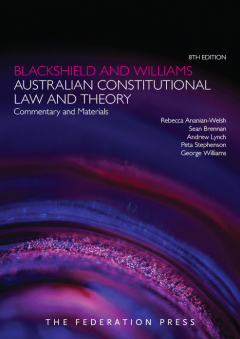
Australia Constitutional law and theory book cover

Rebecca Ananian-Welsh, Sean Brennan, Andrew Lynch, Peta Stephenson and George Williams 

Leading constitutional law scholars George Williams, Sean Brennan and Andrew Lynch are joined by Rebecca Ananian-Welsh and Peta Stephenson for the 8th edition of this acclaimed book on Australian constitutional law. 

The book has been fully revised and updated to include the most recent High Court and overseas decisions, including NZYQ v Minister for Immigration, Citizenship and Multicultural Affairs (2023), Benbrika v Minister for Home Affairs (2023), Farm Transparency International Ltd v New South Wales (2022), Alexander v Minister for Home Affairs (2022), Chetcuti v Commonwealth (2021), Palmer v Western Australia (2021), LibertyWorks Inc v Commonwealth (2021), Love v Commonwealth (2020) and Work Health Authority v Outback Ballooning (2019) and Spence v Queensland (2019).

2023

add
everything you need to know about the voice book cover

George Williams & Megan Davis 

In late 2023 Australians will vote in a referendum on enshrining an Indigenous Voice to parliament and government in the Constitution. What benefits will it bring? And what was the journey to this point? 

Everything You Need to Know about the Voice, written by co-author of the Uluru Statement from the Heart, Cobble Cobble woman Megan Davis, and fellow constitutional expert George Williams, is essential reading on the Voice to parliament and government, how our Constitution was drafted, what the 1967 referendum achieved, what it left unfinished and the Uluru Statement. This updated edition charts the journey of this nation-building reform from the earliest stages of Indigenous advocacy, explores myths and misconceptions and, importantly, explains how the Voice offers change that will benefit the whole nation.

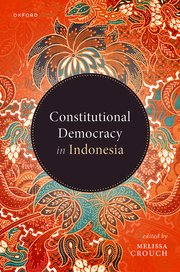
Constitutional democracy in indonesia book cover

Melissa Crouch (ed) 

This volume, with chapters written by leading experts, explores the ongoing debates over the meaning, implementation, and practice of constitutional democracy in Indonesia. This includes debates over the powers of the legislature, the role of the military, the scope of decentralisation, the protection of rights and permissible limits on rights, the regulation of elections, the watchdog role of accountability agencies, and the leading role of the Constitutional Court. These legal issues are analysed in light of the contemporary social, political, and economic environment that has seen a decline in tolerance, freedom, and respect for minorities. Contributions to this volume review the past two decades of reform in Indonesia and assess the challenges to the future of constitutional democracy amidst the wide-spread consensus on the decline of democracy in Indonesia. Demands for amendments to the Constitution and calls to revert to its initial form would be a reversal of Indonesia's democratic gains.

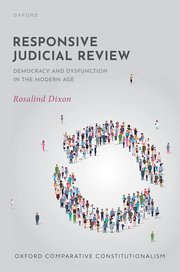
Responsive Judicial Review book cover

Rosalind Dixon 

Democratic dysfunction can arise in both 'at risk' and well-functioning constitutional systems. It can threaten a system's responsiveness to both minority rights claims and majoritarian constitutional understandings. Responsive Judicial Review aims to counter this dysfunction using examples from both the global north and global south, including leading constitutional courts in the US, UK, Canada, India, South Africa, and Colombia, as well as select aspects of the constitutional jurisprudence of courts in Australia, Fiji, Hong Kong, and Korea.

2022

add
From Free to Fair Markets book cover

Rosalind Dixon & Richard Holden 

A new vision of liberalism that is fair and capable of responding to the challenges of a post-COVID world.
 
Liberalism—and its promise of market-led prosperity—was in crisis well before COVID-19. Recent decades have seen a rise in concentrated unemployment and long-term stagnation in real wages in many of the world's leading economies. At the same time, the world has witnessed a dramatic rise of corporate power, concentration of wealth. and the failure of liberal societies to address some of the most pressing challenges of our time. To survive, liberalism will need a radical reboot-to find new ways of tackling the current challenges posed by corporate power, inequality, and climate change.

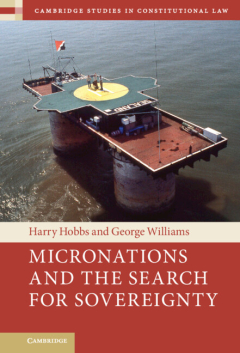
Micronations and the Search for Sovereignty book cover

George Williams and Harry Hobbs 

Political disagreement is a fact of life. It can prompt people to stand for public office and agitate for political change. Others take a different route; they start their own nation. Micronations and the Search for Sovereignty is the first comprehensive examination of the phenomenon of people purporting to secede and create their own country. It analyses why micronations are not states for the purposes of international law, considers the factors that motivate individuals to separate and found their own nation, examines the legal justifications that they offer and explores the responses of recognised sovereign states. In doing so, this book develops a rich body of material through which to reflect on conventional understandings of statehood, sovereignty and legitimate authority. Authored in a lively and accessible style, Micronations and the Search for Sovereignty will be valuable reading for scholars and general audiences.

2021

add
Judcial federalism in australia book cover

Gabrielle Appleby, Anna Olijnyk, James Stellios and John Williams 

Judicial Federalism in Australia: History, Theory, Doctrine and Practice provides a holistic analysis of the federal influence of Chapter III. It considers the historical underpinnings of the Chapter, tracing its development from the colonial justice system through the convention debates and into the first years of Federation. It then provides an overview of the theoretical and doctrinal development of Australia’s Chapter III jurisprudence as it relates to the States and Territories and how it has affected the operation of the federation. Finally, the book provides, for the first time, an empirical study of the effect of the Court’s Chapter III jurisprudence on the development of State and Territory policies, focusing on anti-organised crime initiatives, the introduction of administrative super tribunals and specialist courts such as drug courts and Indigenous sentencing courts.

The automated state book cover

Janina Boughey and Katie Miller (eds)

This book explores the implications, challenges and opportunities that automating government functions presents for our system of public law. It asks whether the laws and institutions we have in place to ensure accountability and transparency in government are fit for purpose in an age of automation. The book brings together judges, senior public servants, practitioners, and law and technology academics to interrogate these issues and find solutions that are workable from legal, technology and policy perspectives.

Woman and the judicary book cover

Melissa Crouch (eds)

Courts can play an important role in addressing issues of inequality, discrimination and gender injustice for women. The feminisation of the judiciary – both in its thin meaning of women's entrance into the profession, as well as its thicker forms of realising gender justice – is a core part of the agenda for gender equality. This volume acknowledges both the diversity of meanings of the feminisation of the judiciary, as well as the complexity of the social and cultural realisation of gender equality. Containing original empirical studies, this book demonstrates the past and present challenges women face to entering the judiciary and progressing their career, as well as when and why they advocate for women's issues while on the bench. From stories of pioneering women to sector-wide institutional studies of the gender composition of the judiciary, this book reflects on the feminisation of the judiciary in the Asia-Pacific.

Abusive constitutional borrowing book cover

Rosalind Dixon & David Landau

Law is fast globalizing as a field, and many lawyers, judges and political leaders are engaged in a process of comparative "borrowing". But this new form of legal globalization has darksides: it is not just a source of inspiration for those seeking to strengthen and improve democratic institutions and policies. It is increasingly an inspiration - and legitimation device - for those seeking to erode democracy by stealth, under the guise of a form of faux liberal democratic cover. 
 
Abusive Constitutional Borrowing: Legal globalization and the subversion of liberal democracy outlines this phenomenon, how it succeeds, and what we can do to prevent it. This book address current patterns of democratic retrenchment and explores its multiple variants and technologies, considering the role of legitimating ideologies that help support different modes of abusive constitutionalism.

The judge, the judiciary and the court book cover

Gabrielle Appleby and Andrew Lynch (eds)

The Judge, the Judiciary and the Court is aimed at anyone interested in the Australian judiciary today. It examines the impact of the individual on the judicial role, while exploring the collegiate environment in which judges must operate. This professional community can provide support but may also present its own challenges within the context of a particular court's relational dynamic and culture. The judge and the judiciary form the 'court', an institution grounded in a set of constitutional values that will influence how judges and the judiciary perform their functions. This collection brings together analysis of the judicial role that highlights these unique aspects, particularly in the Australian setting. Through the lenses of judicial leadership, diversity, collegiality, dissent, style, technology, the media and popular culture, it analyses how judges work individually and as a collective to protect and promote the institutional values of the court.

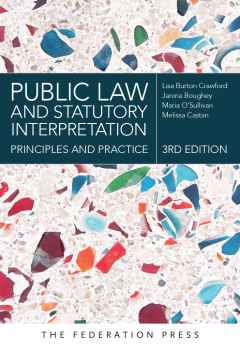
public law and statutary interpretation book cover

Melissa Castan, Maria O’Sullivan, Lisa Burton Crawford and Janina Boughey

This book provides an engaging, comprehensive and reader-friendly overview of Australian public law institutions and principles, together with the principles and process of statutory interpretation. This book is the first text to draw these two topics together to clearly explain how the principles of statutory interpretation reflect the constitutional relationship between the legislative, executive and judicial branches of government.

Everything you need to know about the Uluru statement from the heart book cover

George Williams and Megan Davis

We leave base camp and start our trek across this vast country. We invite you to walk with us in a movement of the Australian people for a better future. 

Everything You Need to Know about the Uluru Statement from the Heart, written by Megan Davis and George Williams, two of Australia’s best-known constitutional experts, is essential reading on how our Constitution was drafted, what the 1967 referendum achieved, and the lead-up and response to the Uluru Statement. Importantly, it explains how the Uluru Statement offers change that will benefit the whole nation.

2020

add
Treaty cover book

George Williams & Harry Hobbs

The leading book on the treaty debate in Australia has been fully revised. The second edition takes a fresh look at modern treaty-making between Indigenous peoples and governments in Australia. Exploring the why, where and how of treaty, it concludes by offering seven strategies for achieving treaty.

interpretating executive power book cover

Janina Boughey and Lisa Burton Crawford (eds)

The breadth of executive power is a topic of enduring concern, yet it is rarely considered through an interpretive lens. This collection of papers from some of Australia’s leading judges, practitioners and academics explores how Australian courts do construe the scope of executive power, and how they should.

2019

add
Government Liability: Principles and Remedies book cover

Janina Boughey, Ellen Rock and Greg Weeks

Given the degree of power wielded by Australian government officials and entities, it is unsurprising that government decisions and conduct frequently impact on individuals. To find the most appropriate way to resolve a particular case, practitioners must be able to work across the traditional legal ‘silos’, drawing on public and private law principles as well as the important, and often under-valued, roles of non-legal accountability mechanisms. This book familiarises readers with some of the complexities underpinning this area and covers public law remedies, private law remedies, and statutory remedies.

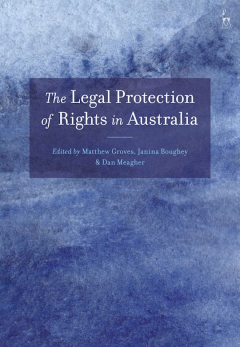
The Legal Protection of Rights in Australia book cover

Janina Boughey, Matthew Groves and Dan Meagher (eds)

How do you protect rights without a Bill of Rights? Australia does not have a national bill or charter of rights and looks further away than ever from adopting one. But it does have a range of individual elements sourced from common law, statute and the Constitution which, though unsystematic, do provide Australians with some meaningful rights protection. This book outlines and explains the unique human rights journey of Australia. It moves beyond the criticisms long made of the Australian position – that its 'formalism', 'legalism' and 'exceptionalism' compromise its capacity for rights protection – to consider how the many elements of its novel legal structure operate. This book analyses the interlocking legal framework for the protection of rights in Australia. A key theme of the book is that the many different elements of a fragmented scheme can add up to something significant, albeit with significant gaps and flaws like any other legal rights protection framework. It shows how the jumbled influences of a common law heritage, a written constitution, differing paths taken by jurisdictions within a single federal state, statutory and common law innovations and a strong dose of comparative legal influences have led to the unique patchwork of rights protection in Australia. It will provide valuable reading for all those researching in human rights, constitutional and comparative law.

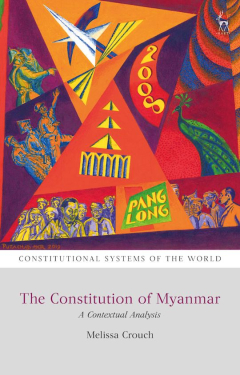
The Constitution of Myanmar book cover

Melissa Crouch

This timely and accessible book is the first to provide a thorough analysis of the 2008 Constitution of Myanmar (Burma) in its historical, political and social context. The book identifies and articulates the principles of the Constitution through an in-depth analysis of legal and political processes and practises, particularly since the 1990s. The core argument of this book is that the 2008 Constitution is crucial to the establishment and maintenance of the military-state. The military-state promotes the leadership role of the military in governance based on a set of ideological commitments and a centralised form of organisation based on the concept of the Union. The book develops this argument by demonstrating how the process of constitution-making and the substance of the 2008 Constitution contribute to its lack of credibility and fuel demands for reform. The vision offered by the 2008 Constitution and its associated institutions has been the subject of fierce contestation, not least, for example, due to concerns over the militarisation of the state. This book is animated by debates over fundamental ideas such as the nature of democracy, the possibility of peace and federalism, the relationship between the executive and the legislature, relations between the Union government and sub-national governments, debates over judicial independence and the oversized role of the Tatmadaw (armed forces). Central to the future of the Constitution and the military-state is the role of the Tatmadaw, which will be a key determinant in any potential shift from the present highly centralised, partly-democratic Union to a federal or decentralised democratic system of governance.

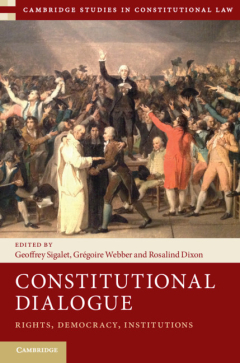
Constitutional dialogue book cover

Rosalind Dixon, Gregoire Webber and Geoffrey Sigalet (eds)

The metaphor of 'dialogue' has been put to different descriptive and evaluative uses by constitutional and political theorists studying interactions between institutions concerning rights. It has also featured prominently in the opinions of courts and the rhetoric and deliberations of legislators. This volume brings together many of the world's leading constitutional and political theorists to debate the nature and merits of constitutional dialogues between the judicial, legislative, and executive branches. Constitutional Dialogue explores dialogue's democratic significance, examines its relevance to the functioning and design of constitutional institutions, and covers constitutional dialogues from an international and transnational perspective.

Law Under a Democratic Constitution book cover

Lisa Burton Crawford, Patrick Emerton and Dale Smith (eds)

Jeffrey Goldsworthy is a renowned constitutional scholar and legal theorist whose work on the powers of Parliament and the interpretation of constitutional and statute laws has helped shape debates on these topics across the English-speaking world. The importance of democratic constitutionalism is central to Professor Goldsworthy's work: it lies at the heart of his defence of Parliamentary supremacy and shapes his approach to both constitutional and statutory interpretation. In honour of Professor Goldsworthy's retirement, this collection provides new perspectives from a range of leading public law scholars and theorists on the legal and philosophical principles that govern the making and interpretation of laws in a constitutional democracy. It also addresses some of the challenges to democratic constitutionalism that have arisen in light of contemporary developments in Australia, Canada, New Zealand, the United Kingdom and the United States.

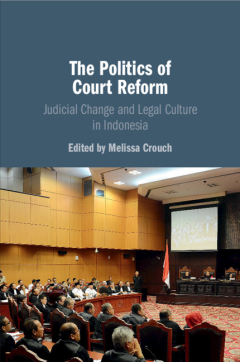
The Politics of Court Reform book cover

Melissa Crouch (eds)

Indonesia is the world's third largest democracy and its courts are an important part of its democratic system of governance. Since the transition from authoritarian rule in 1998, a range of new specialised courts have been established from the Commercial Courts to the Constitutional Court and the Fisheries Court. In addition, constitutional and legal changes have affirmed the principle of judicial independence and accountability. The growth of Indonesia's economy means that the courts are facing greater demands to resolve an increasing number of disputes. This volume offers an analysis of the politics of court reform through a review of judicial change and legal culture in Indonesia. A key concern is whether the reforms that have taken place have addressed the issues of the decline in professionalism and increase in corruption. This volume will be a vital resource for scholars of law, political science, law and development, and law and society.

2018

add
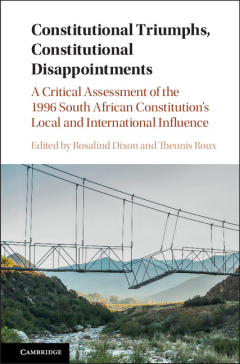
Constitutional Triumphs, Constitutional Disappointments book cover

Rosalind Dixon and Theunis Roux (eds)

The 1996 South African Constitution was promulgated on 18th December 1996 and came into effect on 4th February 1997. Its aspirational provisions promised to transform South Africa's economy and society along non-racial and egalitarian lines. Following the twentieth anniversary of its enactment, this book, co-edited by Rosalind Dixon and Theunis Roux, examines the triumphs and disappointments of the Constitution. It explains the arguments in favor of the Constitution being replaced with a more authentically African document, untainted by the necessity to compromise with ruling interests predominant at the end of apartheid. Others believe it remains a landmark attempt to create a society based on social, economic, and political rights for all citizens, and that its true implementation has yet to be achieved. This volume considers whether the problems South Africa now faces are of constitutional design or implementation, and analyses the Constitution's external influence on constitutionalism in other parts of the world.

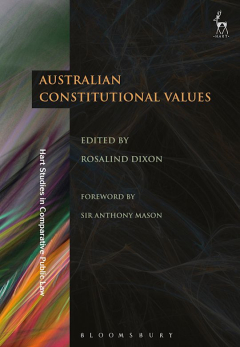
Australian Constitutional Values book cover

Rosalind Dixon (eds)

Vigorous debate exists among constitutional scholars as to the appropriate 'modalities' of constitutional argument, and their relative weight. Many scholars, however, argue that one important modality of constitutional argument involves attention to underlying constitutional purposes or 'values'. In Australia, this kind of values-oriented approach has been advocated by leading constitutional scholars, and also finds support in the judgments of the High Court at various times, particularly during the Mason Court era. Much of the scholarly debate on constitutional values to date, however, focuses on whether the Court should in fact look to constitutional values in this way, not the kinds of values the Court should consider, given such an approach. 

This book responds to this gap in the existing scholarly literature, by inviting a range of leading Australian constitutional lawyers and scholars to address the relevance and scope of various substantive constitutional values, and how they might affect the Court's approach to constitutional interpretation in various contexts.

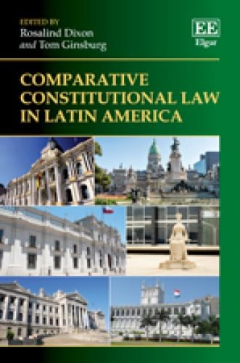
Comparative Constitutional Law in Latin America book cover

Rosalind Dixon and Tom Ginsburg (eds)

This book provides unique insights into the practice of democratic constitutionalism in one of the world’s most legally and politically significant regions. It combines contributions from leading Latin American and global scholars to provide ‘bottom up’ and ‘top down’ insights about the lessons to be drawn from the distinctive constitutional experiences of countries in Latin America. In doing so, it also draws on a rich array of legal and interdisciplinary perspectives. Ultimately, it shows both the promise of democratic constitutions as a vehicle for social, economic and political change, and the variation in the actual constitutional experiences of different countries on the ground – or the limits to constitutions as a locus for broader social change.

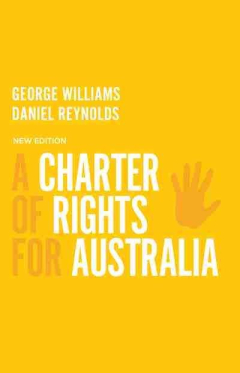
A Charter of Rights for Australia book cover

Daniel Reynolds and George Williams 

Australia does not have a bill or charter of rights, which means there is no comprehensive law that enshrines human rights in Australia – even though these laws are standard in the rest of the developed world. So what does this mean for the rights of Australian citizens? 

In this fully revised fourth edition of A Charter of Rights for Australia, George Williams and Daniel Reynolds show that human rights are not adequately protected in Australia, contrary to what many of us think.

Blackshield and Williams Australian Constitutional Law and Theory book cover

George Williams, Sean Brennan and Andrew Lynch

This is the new and fully updated edition of the acclaimed and authoritative book on Australian constitutional law. Fresh material reflects the contemporary approach of the High Court including its emphasis on statutory interpretation as a tool of constitutional analysis.

2017

add
Australia's constitution after whitlam book cover

Brendan Lim

Australia's constitutional crisis of 1975 was not simply about the precise powers of the Senate or the Governor-General. It was about competing accounts of how to legitimate informal constitutional change. For Prime Minister Gough Whitlam, and the parliamentary tradition that he invoked, national elections sufficiently legitimated even the most constitutionally transformative of his goals. For his opponents, and a more complex tradition of popular sovereignty, more decisive evidence was required of the consent of the people themselves. This book traces the emergence of this fundamental constitutional debate and chronicles its subsequent iterations in sometimes surprising institutional configurations: the politics of judicial appointment in the Murphy Affair; the evolution of judicial review in the Mason Court; and the difficulties Australian republicanism faced in the Howard Referendum. Though the patterns of institutional engagement have varied, the persistent question of how to legitimate informal constitutional change continues to shape Australia's constitution after Whitlam.

The politics of legality in a neoliberal age book cover

Ben Golder and Daniel McLoughlin (eds)

This volume addresses the relationship between law and neoliberalism. Assembling work from established and emerging legal scholars, political theorists, philosophers, historians, and sociologists from around the world – including the Americas, Australia, Europe, and the United Kingdom – it addresses the conceptual, legal, and political relationships between liberal legality and neoliberal economics. More specifically, the book analyses the role that legality plays in the dominant economic force of our time, offering both a legal corrective to scholarship in economics and political economy that has paid insufficient attention to legal ideas, and, at the same time, a political economic corrective to legal scholarship that has only recently turned to theorizing neoliberalism. It will be of enormous interest to those working at the intersection of law and politics in our neoliberal age.


A Charter of Rights for Australia book cover

Daniel Reynolds and George Williams

Australia does not have a bill or charter of rights, which means there is no comprehensive law that enshrines human rights in Australia – even though these laws are standard in the rest of the developed world. So what does this mean for the rights of Australian citizens? In this fully revised fourth edition of A Charter of Rights for Australia, George Williams and Daniel Reynolds show that human rights are not adequately protected in Australia, contrary to what many of us think. Using some pressing examples, they demonstrate how the rights of people at the margins of our society are violated in often shocking ways. Several states and territories have adopted their own charters of rights, or have a charter well underway. This book’s argument that the time has come to adopt a charter at the federal level is more urgent than ever.

Comparative constitutional law in latin america book cover

Rosalind Dixon and Tom Ginsburg (eds)

This book provides unique insights into the practice of democratic constitutionalism in one of the world’s most legally and politically significant regions. It combines contributions from leading Latin American and global scholars to provide ‘bottom up’ and ‘top down’ insights about the lessons to be drawn from the distinctive constitutional experiences of countries in Latin America. In doing so, it also draws on a rich array of legal and interdisciplinary perspectives. Ultimately, it shows both the promise of democratic constitutions as a vehicle for social, economic and political change, and the variation in the actual constitutional experiences of different countries on the ground – or the limits to constitutions as a locus for broader social change.
The Business of Transition- Law Reform, Development and Economics in Myanmar book cover

Melissa Crouch (ed)

This interdisciplinary volume offers a timely reflection on law, development and economics through empirical and comparative perspectives on contemporary Myanmar. The book explores the business that takes place in times of major political change through law and development initiatives and foreign investment. The expert contributors to this volume identify the ways in which law reform creates new markets, embodies hopes of social transformation and is animated by economic gain. This book is an invitation to think carefully and critically about the intersection between law, development and economics in times of political transition. The chapters speak to a range of common issues - land rights, access to finance, economic development, the role of law including its potential and its limits, and the intersection between local actors, globalised ideas and the international community. This interdisciplinary book is for students, scholars and practitioners of law and development, Asian studies, political science and international relations.

2016

add
The Critical Judgments Project book cover

Gabrielle Appleby and Rosalind Dixon (eds)

This book introduces students to a number of critical legal perspectives and demonstrates how such perspectives might be used to influence and reimagine existing legal doctrines. It extends the seminal Feminist Judgments Project and adapts it specifically for the purpose of teaching critical legal thinking. Each chapter provides extracts and commentary on the prominent thinkers within the critical discipline before a leading critical scholar rewrites the judgment in the famous 2013 decision of the High Court of Australia, Monis v The Queen, informed and reimagined through this perspective.

The Tim Carmody Affair book cover

Rebecca Ananian-Welsh, Gabrielle Appleby and Andrew Lynch

When Tim Carmody was appointed Chief Justice of Queensland by Premier Campbell Newman in 2014, he had been Chief Magistrate for only nine months. It proved to be the most controversial judicial appointment in Australia’s history. Carmody’s elevation plunged the Supreme Court and the legal profession into a bitter conflict with the government and with Carmody himself. How did he come to be appointed to such a significant position? What can we learn from this saga about the fragile relationships between politics and the courts? The Tim Carmody Affair places the full story of Carmody’s damaging and divisive tenure in context, and identifies key reforms that could prevent this kind of controversy in the future.
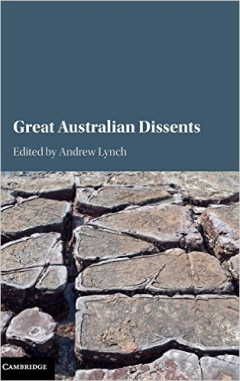
Great Australian Dissents book cover

Andrew Lynch (ed)

When judges disagree, those in the minority write a dissenting opinion. This book considers the great dissents in Australian law. Their worth may derive from numerous factors. Through a diverse selection of memorable dissenting opinions, this book illuminates the topic of judicial disagreement more generally - not only through examples of instances when minority opinions have been distinctly valuable, but by drawing out a richer understanding of the attributes and circumstances which lead some dissents to become iconic, while so many lie forgotten.

The Role of the Solicitor-General book cover

Gabrielle Appleby

This book goes behind the scenes of government - drawing from interviews with over 45 government and judicial officials - to uncover the history, theory and practice of the Australian Solicitor-General. The analysis reveals a role that is of fundamental constitutional importance to ensuring both the legality and the integrity of government action, thus contributing to the achievement of rule of law ideals.

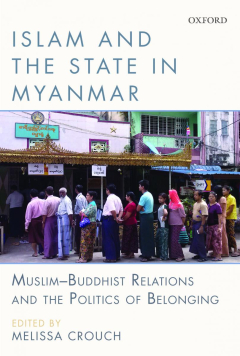
Islam and the State in Myanmar book cover

Melissa Crouch (ed)

This volume explores the relation between Islam and the state in Buddhist-majority Myanmar from both an empirical and a comparative perspective.It provides an informed response to contemporary issues facing the Muslim communities of Myanmar, furthering knowledge of the interaction between state institutions, government policies, and Muslim communities of the past and the present. The book provides scholarly insights into the politics of belonging for Muslims in Myanmar. This book is essential reading for scholars and students studying Islam in the region.

Soft Law and Public Authorities- Remedies and Reform book cover

Greg Weeks

This book considers the phenomenon of soft law employed by domestic public authorities. Lawyers have long understood that public authorities are able to issue certain communications in a way that causes them to be treated like law, even though they lack legislative force. Soft law succeeds as a regulatory tool because people tend to treat it as binding even though public authorities know that it is not. It follows that soft law’s ‘binding’ effects do not apply equally between the public authority and those to whom it is directed. Consequently, soft law is both highly effective as a means of regulation, and inherently risky for those who are regulated by it. This book departs from previous examinations of the regulatory effectiveness of soft law to examine the possible remedies which might follow a public authority breaching its own soft law. It considers judicial review remedies, modes of compensation which are not based upon a finding of invalidity, namely tort and equity, and ‘soft’ challenges outside the scope of the courts, such as through the Ombudsman or by seeking an ex gratia payment.

2015

add
Foucault and the Politics of Rights book cover

Ben Golder

This book focuses on Michel Foucault's late work on rights in order to address broader questions about the politics of rights in the contemporary era. As several commentators have observed, something quite remarkable happens in this late work. In his early career, Foucault had been a great critic of the liberal discourse of rights. Suddenly, from about 1976 onward, he makes increasing appeals to rights in his philosophical writings, political statements, interviews, and journalism. He not only defends their importance; he argues for rights new and as-yet-unrecognized. Does Foucault simply revise his former positions and endorse a liberal politics of rights? Ben Golder proposes an answer to this puzzle, which is that Foucault approaches rights in a spirit of creative and critical appropriation.

NativeTitle From Mabo to Akiba book cover

Sean Brennan, Megan Davis, Brendan Edgeworth and Leon Terrill (eds)

This edited collection provided a realistic assessment of the achievements, frustrations and possibilities of native title, two decades since the enactment of the Native Title Act 1993 (Cth), and after the most significant High Court decision on native title in more than ten years, Akiba v Commonwealth, which confirmed the existence of commercial native title fishing rights.

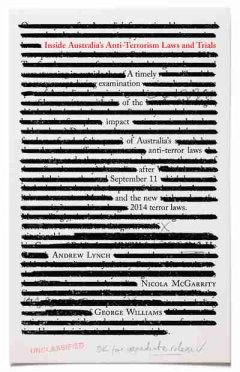
Inside Australia’s Anti-Terrorism Laws and Trials book cover

Andrew Lynch, Nicola McGarrity-White and George Williams

Over ten years after Australia’s first national laws were enacted to combat the threat of terrorism, yet more anti-terrorism laws were passed in the Australian Parliament in late 2014. This book asks whether Australia really needed to enact anti-terrorism laws in the first place, let alone add to them.

Referendum to Recognise Indigenous Australians book cover

Megan Davis and George Williams

This book explains everything that Australians need to know about the proposal to recognise Aboriginal peoples in the Constitution. It details how our Constitution was drafted, and shows how Aboriginal peoples came to be excluded from the new political settlement.

The High Court, the Constitution and Australian Politics book cover

Rosalind Dixon and George Williams (eds)

This publication s is an in-depth exploration of the relationship between decisions of the High Court and broader political currents in Australia and investigages the patterns and effects of constitutional invalidation and dissent on the High Court over time, and their correlation with political trends and attitudes. It also examines the role of constitutional amendment in expressing popular constitutional understandings in the Australian system.

Undemocratic Political Parties and Beyond book cover

Svetlana Tyulkina

This book offers a broad comparative look at the legal concept of militant democracy. It analyses both theoretical and substantive aspects of this concept, investigating its practice in a number of countries and on a diverse array of issues. Svetlana maps the historical development of militant democracy in constitutional theory and explores its interaction with various traditional and contemporary notions of democracy.

2014

add
Commentary and Materials book cover

Sean Brennan, Andrew Lynch and George Williams

In its sixth edition, this publication has undergone a major rewrite. Every chapter has been reviewed and revised, with fresh choices made for cases and extracts to ensure that the book reflects the contemporary approach of the High Court and recent Australian and international scholarship.

Critical Debates on Counter-Terrorist Judicial Review book cover

Fergal Davis and Fiona de Londras (eds)

This publication looks at judicial review as an effective and appropriate way to regulate counter-terrorism measures. It brings together voices from all sides of the debate from a broad range of jurisdictions, from North America, Europe and Australasia.

Comparative Constitutional Law in Asia book cover

Rosalind Dixon and Tom Ginsburg (eds)

Comparative constitutional law is a field of increasing importance around the world, but much of the literature is focused on Europe, North America, and English-speaking jurisdictions. The importance of Asia for the broader field is demonstrated here in original contributions that look thematically at issues from a general perspective, with special attention on how they have been treated in East Asian jurisdictions.

Law, Society and Transition in Myanmar book cover

Melissa Crouch and Tim Lindsey (eds)

This publication addresses the dynamics of the legal system of Myanmar/Burma in the context of the dramatic but incomplete transition to democracy that formally began in 2011. It includes contributions from leading scholars in the field on a range of key legal issues now facing Myanmar, such as judicial independence, constitutional law, human rights and institutional reform.

2013

add
Surveillance, Counter-Terrorism and Comparative Constitutionalism book cover

Fergal Davis, Nicola McGarrity and George Williams (eds)

This book focuses on the issue of surveillance and the breadth of topics covered in this collection include: the growth and diversification of mechanisms of mass surveillance, the challenges that technological developments pose for constitutionalism, new actors in the surveillance state (such as local communities and private organisations), the use of surveillance material as evidence in court, and the effectiveness of constitutional and other forms of review of surveillance powers.

David Hume and George Williams

This publication was shortlisted in the Tertiary (Wholly Australian): Scholarly Resource section of the Australian Educational Publishing Awards 2014) and deals with how the Australian Constitution protects human rights. It provides a comprehensive overview and analysis of the key public law principles, including the full range of express and implied rights in the Australian Constitution.